
Last updated November 14, 2026
 AC repair
 Furnace & heating
 Heat pumps
 Ductless mini splits
 Carrier
 Trane
 Goodman
Seasonal tune-up and full diagnostic on your Carrier, Trane, or Goodman system - readings shown to you before any repair is proposed
Diagnosis first, numbers second - you approve the repair price before a single part goes in.
Get your free estimateHVAC Warning Signs: A Plano Homeowner’s Reference Guide
Most warning-sign lists stop at symptoms. “Your AC is making a strange noise” tells you nothing about whether to call today or wait until spring. That’s the problem this guide sets out to fix. A system that cycles on and off every few minutes isn’t “struggling” in some vague, unknowable way. It’s short-cycling, and the cause could be oversized equipment, low refrigerant, or a dirty evaporator coil. The difference between a $15 filter and a major repair comes down to knowing which failure is actually happening. Below, we connect each observable sign to the component behind it, show you how to judge urgency, and explain the information that helps a technician diagnose your system faster. Plano homeowners deal with a specific set of conditions, and this guide is written with those in mind.
Quick Answer
The most urgent HVAC warning signs in Plano are ice on the refrigerant lines, water pooling near the air handler, a burning smell, and loud metallic grinding at startup. These point to refrigerant leaks, blocked condensate drains, electrical problems, or failing motors that can cause secondary damage if ignored. Signs like uneven cooling, mild rattling, or reduced airflow usually allow a scheduled appointment. When in doubt, a quick call to a technician is cheaper than a compressor replacement.
Styles & brands we work with
- AC repair
- Furnace & heating
- Heat pumps
- Ductless mini splits
- Carrier
- Trane
- Goodman
Table of Contents
- Symptom-to-Cause: What Each Warning Sign Actually Means
- Urgent vs. Scheduled: When You Can Wait and When You Can’t
- High-Static Ductwork in West Plano and the Blower Motor Problem
- Normal Sounds vs. Failure Sounds: An Honest Listening Guide
- How to Document and Report Symptoms to Your Technician
- Seasonal Patterns Plano Homeowners Should Track
- When to Call a Professional
- Frequently Asked Questions
Symptom-to-Cause: What Each Warning Sign Actually Means
Every symptom on your system maps to a specific component. The sooner you can connect the two, the better your technician can prepare, and the less likely you are to face a cascading failure. Here’s the mapping we use in the field.
- Ice on the refrigerant lines (the insulated copper pipes near the condenser): Low refrigerant charge from a leak, or restricted airflow across the evaporator coil. Ice on the lines is never normal. It means the coil is running below freezing and insulating itself from the air it’s supposed to cool.
- Warm air from the vents on a cooling call: Refrigerant charge issues, a failed compressor, a reversing valve stuck in the wrong position on a heat pump, or a blower that isn’t moving air. Rule out the thermostat first, then treat it as a live diagnostic.
- Loud startup or a hard shudder when the compressor kicks on: A failing capacitor, a compressor with internal wear, or a contactor that’s pitted and delaying voltage. This is one of the warning signs that can snowball into motor damage quickly.
- Water under the air handler or near the indoor unit: A blocked condensate drain line or a drain pan that’s cracked. In a Plano summer, the condensate line runs constantly. A blockage backs water into the pan, and eventually into the closet, ceiling, or hallway floor.
- Rattling or buzzing from the outdoor unit: Loose fan blades, a failing fan motor bearing, or debris stuck in the housing. Harmless if caught early. Expensive if the fan seizes and the compressor overheats.
- Short cycling (on-off every few minutes): Oversized equipment, low refrigerant, a dirty evaporator coil, or a thermostat placed in a spot with poor airflow. The compressor never finishes a cycle, and the wear adds up.
You don’t need to diagnose your own system. You do need to describe it accurately, and this table gets you most of the way there. Plano summers are long and hot, and a system that limps through August is a system that’s probably not going to make it through the next one without help.
Urgent vs. Scheduled: When You Can Wait and When You Can’t
Not every warning sign is an emergency, and treating every rattle like a crisis leads to poor decisions and wasted money. The real question is: what happens if you wait a week? Some failures cost you a service call. Others cost you a compressor, a ceiling, or a wall.
Schedule an appointment within the week for:
- Uneven cooling between rooms, or one zone consistently warmer
- Mild rattling, buzzing, or humming without other symptoms
- Reduced airflow at the vents
- A thermostat that responds slowly or runs the system longer than usual
- Higher-than-expected energy bills with no other visible change
Call the same day for:
- Ice on the refrigerant lines or anywhere on the outdoor unit
- Water actively pooling around the indoor air handler
- A burning smell, hot plastic smell, or scorch marks near the unit
- Loud metallic grinding, scraping, or a compressor that won’t start
- Complete loss of cooling during a heat advisory
- Repeated tripping of the breaker when the system calls for cool
The same-day list is about preventing secondary damage. Ice on the lines means the compressor is running under a load it can’t shed. Water near the air handler means mold, drywall damage, or an electrical hazard in the same closet. A burning smell is a fire risk, not a diagnostic question. If you’re unsure which list a symptom falls on, describe it to a technician by phone. In our experience, that two-minute conversation is the difference between a repair and a replacement.
For general diagnosis and repair, our ac repair page walks through what a visit involves. The decision to repair versus replace belongs in a separate conversation, and we don’t push either direction without data.
High-Static Ductwork in West Plano and the Blower Motor Problem
Certain West Plano homes built in the 1990s share a ductwork design quirk that shows up as recurring blower motor failure. The ducts on those builds were often run with tighter turns, longer runs, and fewer return-air paths than current load calculations recommend. The result is high static pressure. The blower motor has to work harder to push the same air, it runs hotter, and it wears faster.
Here’s why that matters for diagnosis: high-static blower failure doesn’t usually present as “the blower stopped.” It presents as intermittent cooling loss. The motor overheats, trips its internal thermal limit, cools down, and restarts. To the homeowner, the air comes back on its own after twenty minutes. To a technician who isn’t listening for that pattern, it can look like a thermostat issue or a refrigerant complaint.
If you live in a West Plano neighborhood with homes from that era and you’ve replaced a blower motor before, or you’re seeing cooling that comes and goes without a pattern, ask your technician to measure static pressure across the system. It’s a straightforward test, and it separates a ductwork problem from an equipment problem. If you’re replacing the system rather than repairing it, our ac installation page covers how static pressure is factored into equipment selection. Brand-neutral advice matters here. A Goodman or York unit sized for a duct system that can’t handle the airflow will fail the same way the old one did.
Similar patterns show up in older Plano housing stock where a previous owner added square footage without touching the ducts. The equipment was upsized; the ductwork wasn’t. The blower motor becomes the part that tells you something was mismatched.
Normal Sounds vs. Failure Sounds: An Honest Listening Guide
Homeowners often describe a noise as “strange” or “weird” because they don’t have a baseline. A well-running system does make noise. Here’s what’s normal, and what isn’t.
Normal operation sounds
- A soft hum from the outdoor condenser while running
- A gentle whoosh of air from the supply vents
- A click from the thermostat or contactor when the system cycles
- The fan running steadily on the outdoor unit with a light breeze at the top
- Light ticking as the unit cools down after a cycle in hot weather
Failure sounds (listen for these specifically)
- Metallic grinding or scraping at the outdoor unit: A fan blade contacting the housing or a fan motor bearing failing. Loud, rhythmic, and not something that fixes itself.
- A hard “clunk” at startup that repeats: Contactor pitting or a compressor valve issue. This often precedes a no-start condition.
- High-pitched squealing from the indoor unit: A failing blower motor bearing or a slipping belt on older equipment.
- Buzzing that continues after the outdoor fan stops: A stuck contactor or a compressor that’s trying to start without adequate voltage.
- Rattling that gets worse over days: Loose panels or debris in the housing. Left alone, debris can bend the fan blade.
- Hissing or a bubbling sound near the refrigerant lines: Refrigerant escaping. This is a “call today” sound.
The most useful data point is change. A unit that has always made a low hum is fine. A unit that started humming differently three days ago is telling you something. If the noise is new, you’ve got your answer for the technician: “It started three days ago and it’s getting louder.” That sentence saves diagnostic time.
How to Document and Report Symptoms to Your Technician
What homeowners typically say: “It’s not cooling.” What actually helps a technician diagnose quickly is a specific pattern of observations. You don’t need a technical vocabulary. You need to answer four questions.
- When did it start, and has it gotten worse? “Started two days ago, getting worse” is more useful than “It’s been doing this for a while.”
- Is it constant or intermittent? If it comes and goes, note the interval. “Runs for about ten minutes, shuts off for twenty, then starts again” points directly to the blower motor thermal-limit pattern described in the West Plano section above.
- What else changed at the same time? New thermostat, recent power surge, recent filter change, new furniture blocking a return, or a door or window left open during a heat wave. Those are real diagnostic clues.
- Where is the symptom? Indoor, outdoor, or both? “Ice on the outdoor unit only” and “ice on the indoor lines” mean different things. “Water under the indoor unit” points to condensate. “Water near the outdoor unit” usually means the unit is sweating, which is normal.
Take a photo. Ice on the lines, a puddle, a scorched spot, or a fan blade that’s not spinning is worth more to a technician than three paragraphs of description. If the system is making an alarming noise, take a short video. Fifteen seconds of grinding tells the story better than a description ever will.
Also worth writing down: the make and model of the equipment, usually on a plate on the outdoor unit and inside the air handler cabinet. When the technician knows the equipment, the guesswork goes away. We work on Carrier, Trane, Lennox, Goodman, Rheem, York, Daikin, Bryant, and American Standard, so the make and model lets us arrive prepared rather than arriving and then figuring it out. If you have records from previous repairs, have them on hand as well. A prior capacitor replacement, a refrigerant top-off, or a blower motor swap changes the diagnosis.
Seasonal Patterns Plano Homeowners Should Track
Plano’s climate puts specific stresses on a residential system, and those stresses show up on a predictable calendar. Tracking these patterns helps you know when to expect certain warning signs.
- Late spring, before the first sustained heat: The first serious cooling day of the year exposes any capacitor that aged out over winter, any thermostat that’s misreading, and any refrigerant charge that’s drifted low. This is the time warning signs are most likely to appear suddenly. If you can catch them before the first heat wave, the repair happens at your schedule, not your system’s.
- Mid-summer: Long runtimes under high load are when short cycling, ice on the lines, and condensate backups show up. The condensate drain line is running constantly, and any partial blockage gets worse.
- First cold snap: Furnace ignition problems, flame sensor faults, and blower issues surface on the heating side. These don’t always show as a clear failure. Sometimes the furnace runs, but the blower doesn’t start, and the safety limit shuts the burner off. That’s a “call today” pattern because it repeats and stresses the heat exchanger.
- Shoulder months (spring and fall): The best window for catching warning signs before they become failures. A scheduled visit during a mild month is easier to arrange and gives you a written record to compare against the next season.
Our Plano page covers what we see in each season and how we staff for the rush. If your calendar doesn’t leave room for a scheduled visit, at least keep a running note on your phone for the symptom pattern. It’s the cheapest diagnostic tool you have.
See the difference
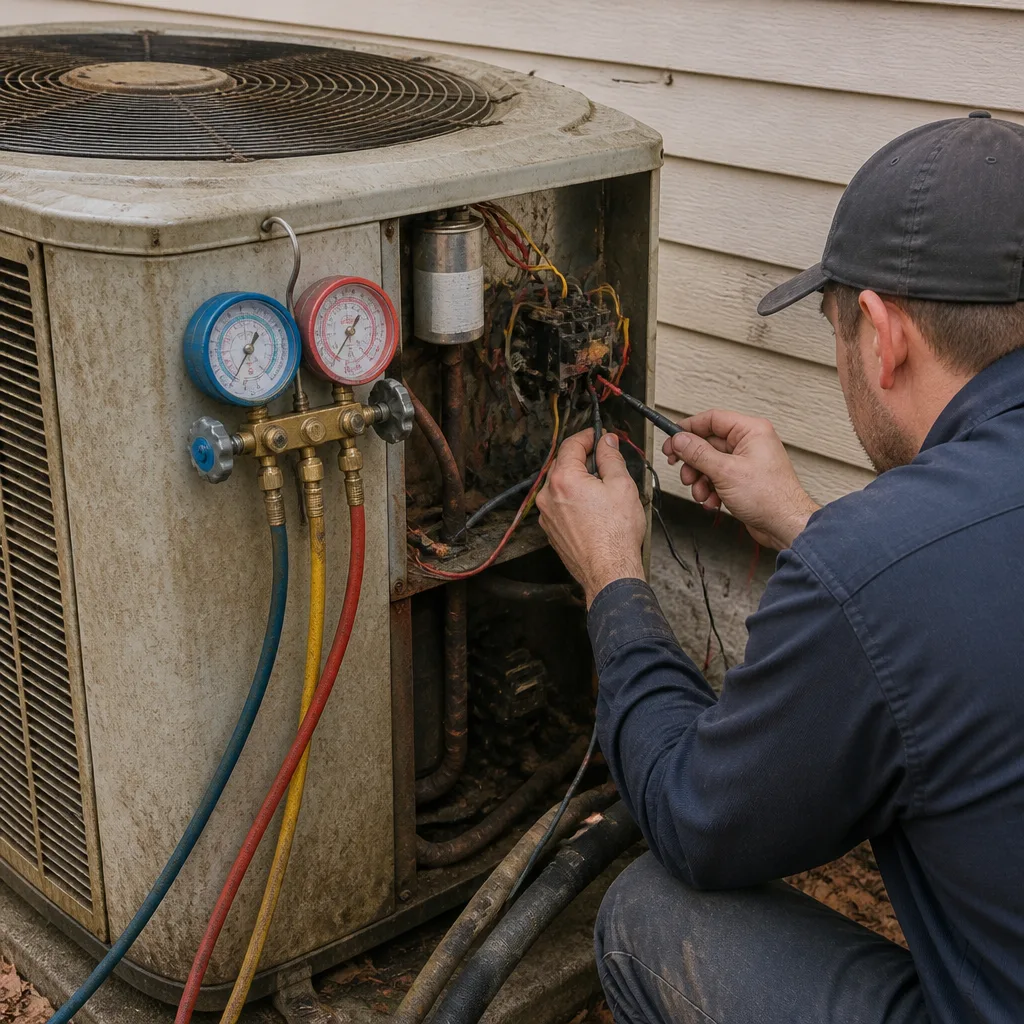 Before
 After
 Before
 After
 Before
 After
Common Mistakes to Avoid
- Assuming ice means it’s low on refrigerant and calling for a “top-off.” Ice on the lines does often mean low charge, but it also means restricted airflow. Topping off refrigerant without finding the leak is a repeat problem. The charge has to go somewhere, and if it’s leaking, it’ll leak again.
- Replacing the thermostat before ruling out the equipment. A thermostat that reads wrong, a blower that’s not moving air, and a refrigerant issue can all present as “the AC just isn’t cooling.” A new thermostat without a diagnostic path is money spent in the wrong direction.
- Running the system with a known issue through a Plano heat advisory. Some systems will limp through high load with a small leak or a marginal capacitor. The risk isn’t that they’ll fail on a good day. It’s that they’ll fail during a stretch of triple-digit heat when service calls are backed up and the compressor takes the brunt.
- Ignoring water near the air handler because the AC is still cooling. The system is working, but the condensate drain isn’t. Water damage to a ceiling or a floor is often more expensive than the repair that would have prevented it.
- Never changing the filter during peak season. A restricted filter raises static pressure and narrows airflow. That’s the same failure mode as the ductwork issue in older Plano homes, and it’s entirely within your control.
- Describing the symptom without the pattern. “The AC isn’t working” gets a general visit. “The AC shuts off every ten minutes, restarts on its own, and started two days ago” gets a technician prepared for a specific component. That difference in information is where diagnosis speed comes from.
- Mixing brands of major component in the same system without a plan. This is mostly an installation question, not a repair question, but it’s worth flagging. A mismatched coil and condenser can work temporarily and still cause charge and efficiency problems.
If you want to compare notes on any of these with the team directly, the Benchmark AC Repair homepage is a good starting point. We’d rather answer a question that saves you a visit than schedule one for a symptom that a filter change would have solved.
When to Call a Professional
Call the same day for ice on the lines, active water near the indoor unit, a burning smell, a breaker that trips when the AC calls, or a compressor that won’t start. Schedule a visit within the week for uneven cooling, new rattles or buzzing, reduced airflow, or rising bills with no other visible change. If you’ve had the same warning sign twice in one cooling season, that’s a call even if it self-clears. Repeated symptoms point to an underlying cause that a reset won’t fix. We answer 24/7. A call outside dispatch hours is booked into the next opening, Sunday through Friday, 7am to 7pm.
Benchmark AC Repair offers free estimates in Plano. Call (833) 488-8546 to book a diagnostic visit or to talk through a symptom before you decide. Our technicians have up to 15 years of experience and work on the major residential brands, so they’ll know your equipment when they arrive. Whatever system you have, we know it.
Frequently Asked Questions
Yes. Ice on the refrigerant lines means the coil is running below freezing, which points to low refrigerant or restricted airflow, and continuing to run the system risks compressor damage. It’s one of the warning signs that belongs on the same-day list. Call (833) 488-8546 to book a diagnostic. We answer 24/7, and a call outside dispatch hours is booked into the next opening, Sunday through Friday, 7am to 7pm.
Short cycling usually means oversized equipment, low refrigerant, a dirty evaporator coil, or a thermostat placed in poor airflow. The cause matters because each one has a different repair, and the wrong repair repeats the problem. In our experience, a technician measuring static pressure, checking charge, and comparing runtime against design load can usually identify the cause in one visit. If it’s been happening for more than a week, book an appointment before the pattern causes a compressor failure.
If your home was built in the 1990s and the ductwork has tighter turns and longer runs than current standards, the blower motor may be overheating and tripping its internal thermal limit. The cooling returns when the motor cools down, which is why it looks intermittent. Ask your technician to measure static pressure, and if you’re replacing the system, make sure the new equipment is sized for the ductwork you actually have.
A steady hum, the whoosh of air from vents, and the fan running on the outdoor unit are normal. Metallic grinding, a repeating clunk at startup, high-pitched squealing, hissing near the lines, or buzzing after the fan stops are failure sounds and worth a call. If the sound is new and getting louder, describe it and mention the pattern. That information changes how fast a technician can diagnose.
You can check the easy things first: the thermostat setting, the breaker, and the air filter. Beyond that, the diagnostic work involves refrigerant handling, electrical testing, and airflow measurement, and those aren’t safe to work on without training. We don’t recommend opening the electrical panel or trying to add refrigerant yourself. What helps most is accurate reporting. Note when the symptom started, whether it’s constant or intermittent, and take a photo or video if you can.
It shouldn’t have to. We’re trained on Carrier, Trane, Lennox, Goodman, Rheem, York, Daikin, Bryant, and American Standard, so there’s no brand we’re not set up to work on. The bigger factor is whether the technician takes the time to measure the system rather than guess. Ask that question before you book. Brand-neutral advice also matters if you’re headed toward replacement.
For additional detail on how we handle installations and what’s involved when a repair isn’t the right answer, see our AC installation page. The decision comes down to the actual condition of your equipment.
The Bottom Line
Every warning sign on your HVAC system points to a specific component. Ice on the lines means low refrigerant or restricted airflow. Water near the air handler means a blocked condensate drain. Short cycling means oversized equipment, low charge, a dirty coil, or a thermostat in the wrong spot. Intermittent cooling loss in a 1990s West Plano home often means high-static ductwork stressing the blower motor. The useful skill isn’t memorizing a symptom list. It’s connecting the observation to the component, judging whether it can wait a week or needs a same-day call, and reporting the pattern accurately so your technician knows what they’re walking into. That’s the version of a warning-sign list that saves money, prevents secondary damage, and keeps your system running through a Plano summer.
If something on this list matches what your system is doing, give us a call. For a free estimate or to book a diagnostic visit, call (833) 488-8546. We answer 24/7. Fast dispatch from 7am to 7pm, Sunday through Friday.
Written by the team at Benchmark AC Repair.